

Spacing and rotations
Spacing and rotations
Section titled “Spacing and rotations”Spacing
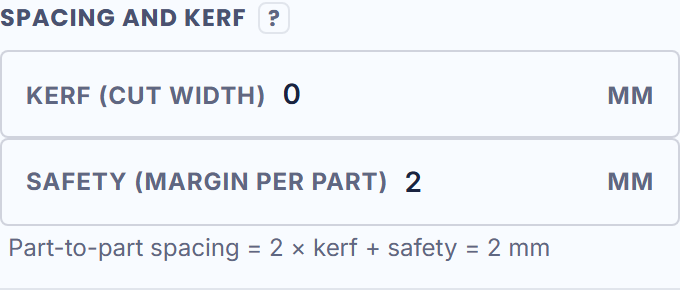
Section titled “Spacing”Between two parts, the cut needs room: the flame has a width (the kerf), and your parts a tolerance margin (the safety). NestorCut’s rule is written under the field:
Spacing between parts = 2 × kerf + safety
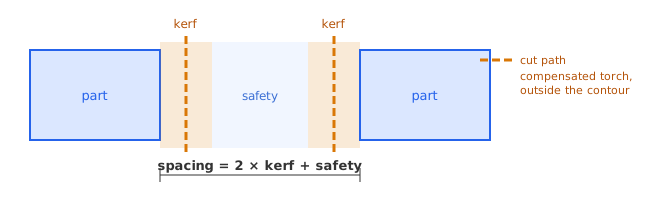
Why twice the kerf: each part is cut on its OWN path — the compensated
torch passes outside the contour, and the whole kerf is eaten OUT of
the part. Two parts face to face: two whole kerfs, plus the safety
between them. A dropped .job pre-fills everything: kerf read from
the tool, spacing computed.
Spacing finer than 0.05 mm triggers a warning — finer than a laser kerf, parts may touch or micro-overlap at cutting. And more spacing means fewer parts in holes: beyond 2.4 mm, nesting inside holes disables itself (an engine limit, said on screen).
Rotations
Section titled “Rotations”The angle step tells the engine by how much it may turn the parts: 90° for rectangular parts, 180° when upside down does not matter, a finer step (45°, 30°…) to save more material on free shapes — at the price of a longer search. “No rotation” keeps everything at 0°: the choice for engraved text and oriented grain.